


Nicolás Lamas
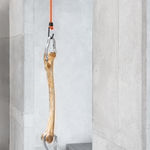
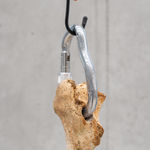
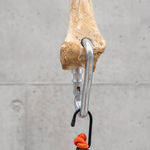
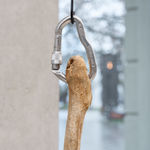
Tendon, 2022
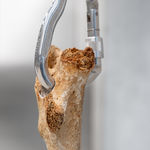
Human bone, carabiner and elastic rope
Dimensions variable
Copyright The Artist
Photo: Dirk Tacke
Weitere Abbildungen
-
(View a larger image of thumbnail 1
)
-
(View a larger image of thumbnail 2
)

-
(View a larger image of thumbnail 3
)

-
(View a larger image of thumbnail 4
)

-
(View a larger image of thumbnail 5
)
-
(View a larger image of thumbnail 6
)
-
(View a larger image of thumbnail 7
)
-
(View a larger image of thumbnail 8
)

-
(View a larger image of thumbnail 9
)
Die Skulpturen von Nicolas Lamas, die sich aus organischen Elementen, präzise gefertigten Strukturen und gebrauchten Alltagsgegenständen zusammensetzen wirken wie hybride Artefakte, die verschiedene Zeitlinien verbinden. Sie spiegeln das Interesse des...
Die Skulpturen von Nicolas Lamas, die sich aus organischen Elementen, präzise gefertigten Strukturen und gebrauchten Alltagsgegenständen zusammensetzen wirken wie hybride Artefakte, die verschiedene Zeitlinien verbinden. Sie spiegeln das Interesse des Künstlers an Archäologie und der Entstehung technischer Errungenschaften über Jahrtausende hinweg. „Technologie entwickelt sich weiter und blickt in die Zukunft, während die Archäologie eine Disziplin ist, die per Definition ständig Daten aus der Vergangenheit sammelt, und zwar anhand der materiellen Spuren, die unsere Vorfahren hinterlassen haben. Manchmal vergessen wir jedoch, dass sich sowohl die Vergangenheit als auch die Zukunft ständig weiterentwickeln.“ Die Assemblagen eröffnen so Dialoge über Vergänglichkeit, Hybridität und die Trennung von Kultur und Natur. Die verschiedenen Materialitäten scheinen zunächst konträr zueinander zu stehen, weisen aber bei genauerer Auseinandersetzung formale und inhaltliche Gemeinsamkeiten auf. Die einzelnen Elemente verfügen für den Künstler über eine eigene Kraft, durch die eine Unterscheidung von menschgemacht und organisch gewachsen hinfällig wird. Durch diese Begegnungen versucht Lamas, die Funktion und den Wert der Dinge zu relativieren und andere Wege zu öffnen, um ihre Existenz neu zu definieren.
„Tendon“ (2022) wirft Fragen zur Beziehung zwischen Knochen, als Träger uralter Erinnerungen und einem der ersten Materialien zur Herstellung von Werkzeugen und Instrumenten, und synthetische Materialien auf, die emblematisch für die Moderne und ihren ökologischen Fußabdruck stehen. „In the end everything changes and moves, everything is in transition to another state or level. In that sense, conditions such as the living and the inert, the unique and the massive, the organic and the synthetic, the material and the virtual, the transcendent and the banal, the human and the non-human, are categories that are constantly mutating and relativizing.“
Nicolas Lamas' sculptures, composed of organic elements, precisely produced structures, and used everyday objects, resemble hybrid artifacts that connect different timelines. They reflect the artist’s interest in archaeology and the development of technological achievements over millennia. “Technology continues to advance and looks toward the future, while archaeology is a discipline that, by definition, constantly gathers data from the past through the material traces left by our ancestors. However, we sometimes forget that both the past and the future are in constant evolution.” The assemblages thus open dialogues about transience, hybridity, and the separation of culture and nature. At first glance, the different materials appear to be in opposition to each other, but upon closer examination, they reveal formal and thematic similarities. For the artist, the individual elements possess their own power, making the distinction between man-made and organically grown irrelevant. Through these encounters, Lamas seeks to relativize the function and value of objects, opening up new ways to redefine their existence.
“Tendon” (2022) raises questions about the relationship between bone, as a carrier of ancient memories and one of the first materials used to make tools and instruments, and synthetic materials, which are emblematic of modernity and its ecological footprint. “In the end, everything changes and moves; everything is in transition to another state or level. In that sense, conditions such as the living and the inert, the unique and the massive, the organic and the synthetic, the material and the virtual, the transcendent and the banal, the human and the non-human, are categories that are constantly mutating and relativizing.”
„Tendon“ (2022) wirft Fragen zur Beziehung zwischen Knochen, als Träger uralter Erinnerungen und einem der ersten Materialien zur Herstellung von Werkzeugen und Instrumenten, und synthetische Materialien auf, die emblematisch für die Moderne und ihren ökologischen Fußabdruck stehen. „In the end everything changes and moves, everything is in transition to another state or level. In that sense, conditions such as the living and the inert, the unique and the massive, the organic and the synthetic, the material and the virtual, the transcendent and the banal, the human and the non-human, are categories that are constantly mutating and relativizing.“
Nicolas Lamas' sculptures, composed of organic elements, precisely produced structures, and used everyday objects, resemble hybrid artifacts that connect different timelines. They reflect the artist’s interest in archaeology and the development of technological achievements over millennia. “Technology continues to advance and looks toward the future, while archaeology is a discipline that, by definition, constantly gathers data from the past through the material traces left by our ancestors. However, we sometimes forget that both the past and the future are in constant evolution.” The assemblages thus open dialogues about transience, hybridity, and the separation of culture and nature. At first glance, the different materials appear to be in opposition to each other, but upon closer examination, they reveal formal and thematic similarities. For the artist, the individual elements possess their own power, making the distinction between man-made and organically grown irrelevant. Through these encounters, Lamas seeks to relativize the function and value of objects, opening up new ways to redefine their existence.
“Tendon” (2022) raises questions about the relationship between bone, as a carrier of ancient memories and one of the first materials used to make tools and instruments, and synthetic materials, which are emblematic of modernity and its ecological footprint. “In the end, everything changes and moves; everything is in transition to another state or level. In that sense, conditions such as the living and the inert, the unique and the massive, the organic and the synthetic, the material and the virtual, the transcendent and the banal, the human and the non-human, are categories that are constantly mutating and relativizing.”