


Nicolás Lamas
Neurocoral, 2022
Aluminum gearbox valve body and coral
13 x 35 x 28 cm
5 1/8 x 13 3/4 x 11 inches
5 1/8 x 13 3/4 x 11 inches
Copyright The Artist
Photo: Dirk Tacke
Weitere Abbildungen
-
(View a larger image of thumbnail 1
)

-
(View a larger image of thumbnail 2
)

-
(View a larger image of thumbnail 3
)
-
(View a larger image of thumbnail 4
)
-
(View a larger image of thumbnail 5
)
-
(View a larger image of thumbnail 6
)

-
(View a larger image of thumbnail 7
)
-
(View a larger image of thumbnail 8
)
-
(View a larger image of thumbnail 9
)
In „Neurocoral“ (2022) liegt eine versteinerte, gehirnförmige Koralle auf einem Ventilkörper, dem Bauteil, das die Bewegung innerhalb des Getriebesystems eines Autos reguliert. Das Werk stellt einen Dialog zwischen zwei Organisationsformen...
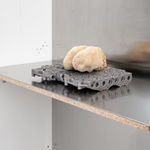
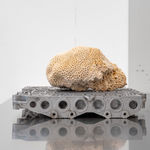
In „Neurocoral“ (2022) liegt eine versteinerte, gehirnförmige Koralle auf einem Ventilkörper, dem Bauteil, das die Bewegung innerhalb des Getriebesystems eines Autos reguliert. Das Werk stellt einen Dialog zwischen zwei Organisationsformen her: der nicht-menschlichen kollektiven Intelligenz der Koralle – einer Kolonie von Polypen, die zusammenarbeiten, um als ein einziger Organismus zu funktionieren – und der mechanischen Logik des Geräts. Das Fossil erscheint als materielle Spur einer verteilten Form des Denkens, bei der Koordination, Interdependenz und gemeinsames Handeln eine gemeinsame Struktur aufrechterhalten. Indem es auf einer technologischen Komponente platziert wird, die mit Kontrolle und Regulierung assoziiert wird, suggeriert das Werk, dass die Grenzen zwischen dem Natürlichen und dem Künstlichen zunehmend durchlässig werden. Es hebt hervor, wie bestimmte lebende Systeme und bestimmte technische Geräte die Logik des Funktionierens, der Reaktion und der Anpassung teilen. Als materielle Aufzeichnung, die verschiedene Zeitlichkeiten und Formen des Handelns zusammenführt, lädt das Werk dazu ein, unser Verständnis von Intelligenz – menschlich, nicht-menschlich oder maschinell – zu überdenken und zu überlegen, wie diese Formen sich miteinander verflechten, gegenseitig beeinflussen und koexistieren.
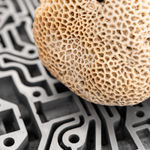
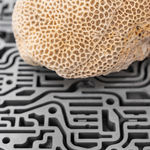
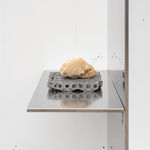
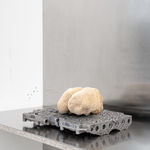
In „Neurocoral“ (2022) a fossilized brain-shaped coral rests on a valve body, the component that regulates movement within a car’s transmission system. The work establishes a dialogue between two modes of organization: the coral’s non-human collective intelligence —a colony of polyps cooperating to function as a single organism— and the mechanical logic of the device. The fossil appears as the material trace of a distributed form of thinking, where coordination, interdependence, and joint action sustain a shared structure. By placing it atop a technological component associated with control and regulation, the piece suggests that the boundaries between the natural and the artificial become increasingly permeable. It highlights how certain living systems and certain technical devices share logics of functioning, response, and adaptation. As a material record that brings together different temporalities and forms of agency, the work invites us to reconsider what we understand as intelligence —human, non-human, or machinic— and how these modes begin to intertwine, influence one another, and coexist.
In „Neurocoral“ (2022) a fossilized brain-shaped coral rests on a valve body, the component that regulates movement within a car’s transmission system. The work establishes a dialogue between two modes of organization: the coral’s non-human collective intelligence —a colony of polyps cooperating to function as a single organism— and the mechanical logic of the device. The fossil appears as the material trace of a distributed form of thinking, where coordination, interdependence, and joint action sustain a shared structure. By placing it atop a technological component associated with control and regulation, the piece suggests that the boundaries between the natural and the artificial become increasingly permeable. It highlights how certain living systems and certain technical devices share logics of functioning, response, and adaptation. As a material record that brings together different temporalities and forms of agency, the work invites us to reconsider what we understand as intelligence —human, non-human, or machinic— and how these modes begin to intertwine, influence one another, and coexist.